

In this page
Set owners
The Set owners quick action sets the users responsible for the content in this page or in this page plus in its descendant pages. Use it to make ownership and accountability explicit for a page or a whole content tree.
How to use
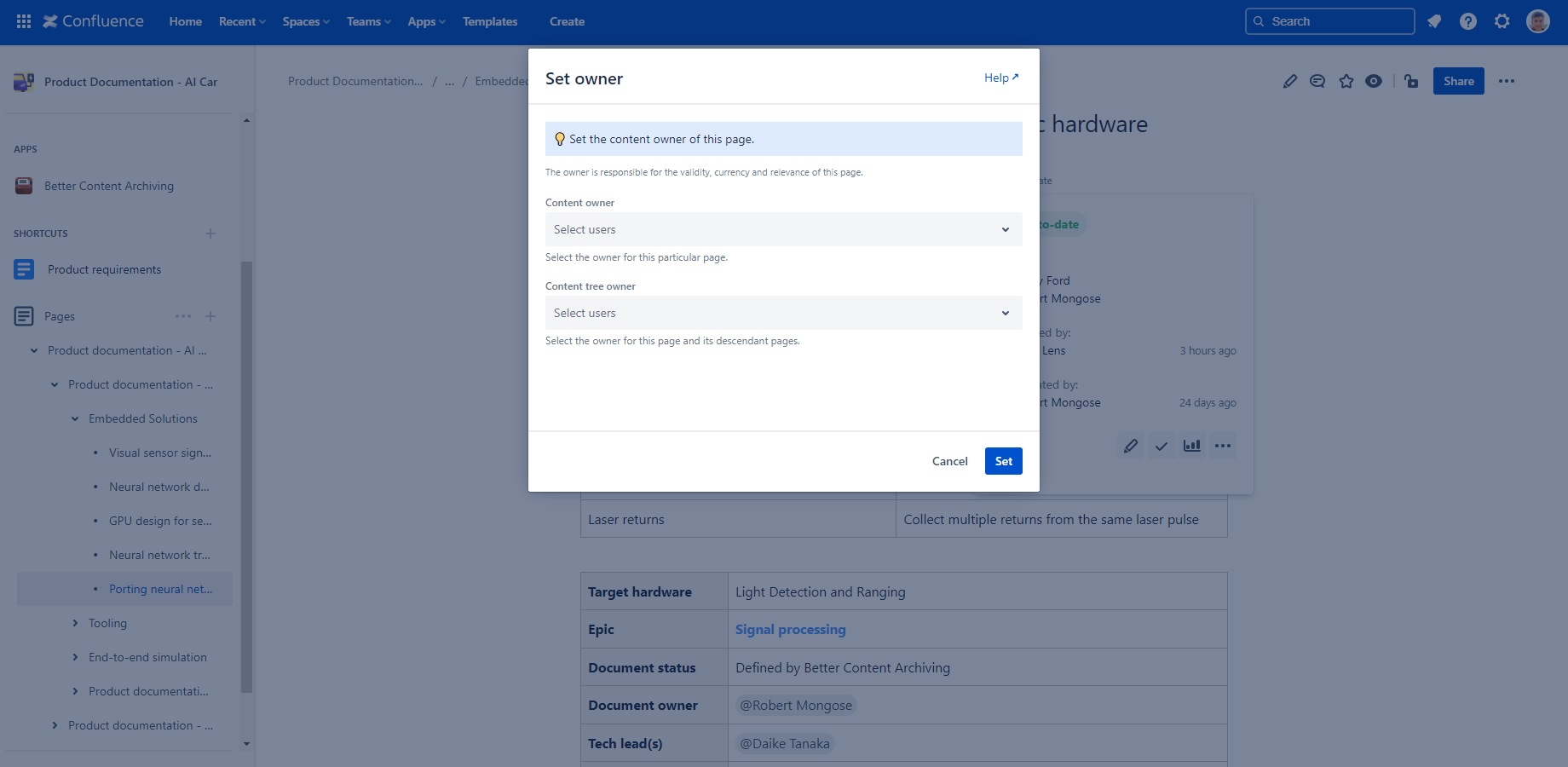
Its icon appears when hovering over the content owners value (or the "Not set" placeholder) in the Content Status Indicator. You can also see inherited owners (if set) and the contents each owner has been inherited from.
Note that for large content trees, propagating owner changes might take up to a few minutes. You cannot change owners on a specific content while another change is still in progress. (If you think a propagation is stuck for a long time and you want to a clean it up, you can either wait for the next scheduled Refresh Content Owners job execution, or you can start it manually.)
Once owners are set, you can put that information to use in several ways, for example:
- Content owners can receive notifications for their owned items by selecting the "Owners" checkbox within the notification scheme.
- Get an overview of ownership, site-wide or per space, on the Content Owner report.
- Search for contents by direct and inherited owners, owner count, or content without owners, using CQL.
Under the hood
Set owners updates or clears the following CQL fields:
-
"Direct owner" fields (owners set as either owners or tree owners on the content itself):
- arch.directOwner
- arch.directOwner.count
- arch.directOwner.setOn
-
"Inherited owner" fields (owners set as tree owners on any ancestors of the content):
- arch.inheritedOwner
- arch.inheritedOwner.count
- arch.inheritedOwner.setOn
-
"Any owner" fields (union of direct and inherited owners of a content):
- arch.anyOwner
- arch.anyOwner.count
- arch.anyOwner.setOn
-
Internal fields (not intended for end users, as they serve as a basis for the calculated fields listed above):
- arch.owner
- arch.owner.count
- arch.owner.setBy
- arch.owner.setOn
- arch.treeOwner
- arch.treeOwner.count
- arch.treeOwner.setBy
- arch.treeOwner.setOn
Questions?
Ask us any time.